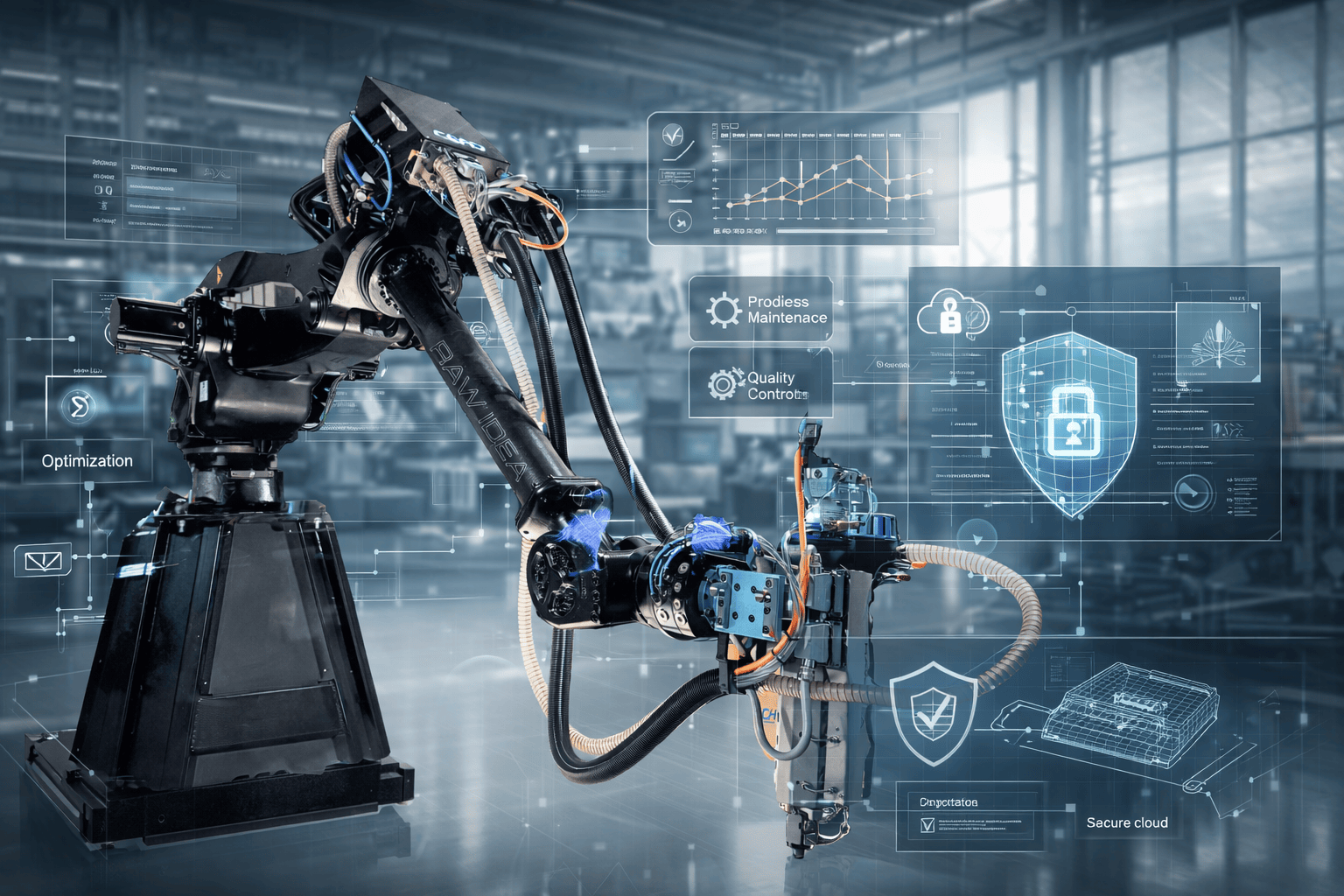
Does data protection hinder the growth of AI in large scale 3D printing?
Within the industry, the question is often raised whether stricter data protection requirements are slowing down the rapid development of artificial intelligence. In sectors where large scale 3D printing processes are becoming increasingly important, this is a highly relevant topic. At RAW Idea, we clearly see that AI can have a major impact on industrial production. Applications such as generative design, process optimisation, real time monitoring and predictive maintenance all show how production environments can become more efficient, reliable and scalable.
The foundation of these AI applications is data. Large scale 3D printing systems generate significant amounts of information, including machine parameters, sensor data, design files, material behaviour and quality measurements. By analysing this data, AI models can identify patterns, improve processes and support further automation.
The role of data in industrial 3D printing
In large scale 3D printing, data is not simply supportive. It is essential to making production smarter and more predictable. The more insight companies have into machine behaviour, material response and product quality, the better they can manage performance, consistency and output.
AI creates clear opportunities in areas such as:
Print parameter optimisation
Real time process monitoring
Predictive maintenance
Quality improvement and repeatability
These applications help companies strengthen production control while creating the conditions for further scale.
Why data protection matters
At the same time, a substantial share of this data is sensitive. In many cases, it involves customer intellectual property, unique design files or process information with competitive value. It is therefore entirely justified that organisations handle the sharing and processing of this data with care.
Regulation and internal requirements around data protection play an important role here. In practice, however, data protection does not necessarily have to slow innovation down. When organisations establish clear agreements on data use, invest in secure digital infrastructures and manage data transparently, trust can actually grow between partners across the production chain.
A condition for progress, not a barrier
For the large scale 3D printing industry, the real challenge lies not only in collecting data, but in organising data protection intelligently. By integrating data governance and security into a digital strategy from the outset, companies can continue developing AI applications without creating unnecessary risks for intellectual property or compliance.
At RAW Idea, this is an area that receives deliberate attention. We see that reliable digitalisation depends on combining technical progress with responsible data management.
Looking ahead
Data protection does not have to be a barrier to the growth of AI in industrial 3D printing. On the contrary, when properly organised, it can become the foundation for trusted collaboration, further digitalisation and long term innovation in manufacturing. The companies that approach this carefully from the beginning will be better positioned to innovate with confidence.