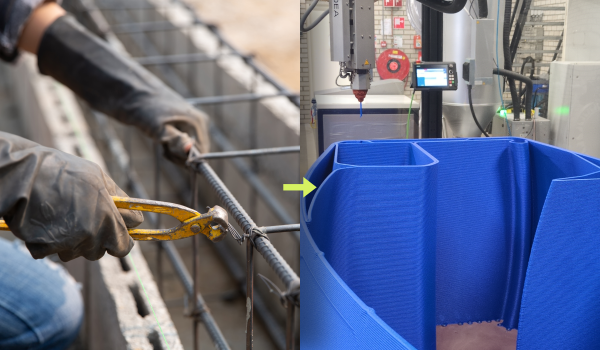
Why this matters now
The construction industry is under pressure to reduce carbon emissions, improve material efficiency, and adopt more circular practices. At the same time, traditional concrete reinforcement, mainly steel, is being re-examined in light of new manufacturing technologies and material possibilities.
Within this shift, 3D-printed thermoplastics are emerging as an alternative. What was once limited to prototyping is now evolving into a method for creating structurally relevant, highly optimized components, becoming a shift in how we design reinforcement.
Beyond steel: a new way of thinking about reinforcement
Concrete needs reinforcement because it is weak in tension. Steel has long been the default solution due to its strength and reliability. However, this conventional approach also brings limitations: high carbon impact, corrosion risk, and restricted design freedom.
The key insight from recent explorations at Raw Idea is that performance is not determined by material alone, but by the interaction between material and geometry. While plastics are often seen as weaker than steel, this view ignores the possibilities of design-driven optimization.
Geometry as a performance driver
With 3D printing, reinforcement is no longer limited to straight bars or standard meshes. Instead, it can take the form of lattices, open grids, or plate-based structures that significantly increase the contact area with concrete.
This increased interface improves load transfer, which is critical for structural performance. In practice, optimized thermoplastic geometries consistently outperform simple rod-like plastic reinforcements.
Rather than copying steel in plastic, additive manufacturing allows reinforcement to be redesigned from first principles.
Performance through design
In carefully engineered configurations, 3D-printed plastic reinforcement can contribute meaningfully to flexural strength in concrete elements. While it does not replace steel in all applications, it can achieve a substantial share of its structural function in specific use cases.
An additional advantage is deformation behavior. Well-designed thermoplastic structures can show more gradual, controlled failure modes, which can be beneficial in certain structural contexts.
Sustainability benefits
Beyond performance, sustainability is a major driver. Using recycled or bio-based thermoplastics can reduce environmental impact, while 3D printing minimizes material waste and enables production on demand.
This allows for more localized, efficient manufacturing and supports the broader shift toward circular construction systems.
From material-driven to design-driven thinking
At Raw Idea, plastic reinforcement is not seen as a direct replacement for steel, but as part of a broader shift in thinking. The real opportunity lies in moving from standardized solutions to performance-driven design.
Additive manufacturing enables this by removing geometric constraints and allowing reinforcement to be tailored to function rather than manufacturing limits.
Looking ahead
3D-printed thermoplastic reinforcement is still developing, but it signals a clear direction: the future of concrete reinforcement will be defined less by material choice and more by design intelligence.
The opportunity is not to replace steel, but to rethink reinforcement altogether, and in doing so, unlock a new generation of lighter, smarter, and more sustainable structures.