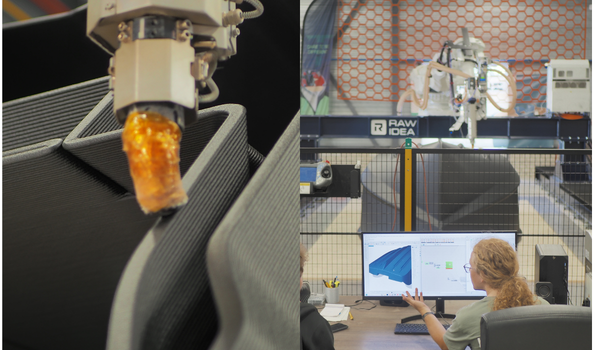
Walnut 3D Printing: Bringing Wood Into Large-Scale Additive Manufacturing
What happens when you combine the possibilities of large-scale 3D printing with one of the oldest materials in design?
This month, RAW Idea began exploring that question through a collaboration with a small material studio in Copenhagen focused on redefining how we work with wood.
The result is a material that doesn't just look like wood. The texture is there. The smell is there. And the possibilities are worth exploring.
A new form of wood
Wood has always had a strong place in furniture and interior design. Its natural texture, warmth, and character make it a material that people connect with.
But working with wood through additive manufacturing opens up a different set of possibilities.
Instead of cutting a material down to create a shape, 3D printing allows the material to become part of the process of building the shape itself.
For RAW Idea, that's what makes this exploration interesting.
We're not simply looking for a way to make something that resembles wood. We're interested in understanding how wood-based materials can behave within large-scale additive manufacturing and what that could mean for designers, architects, and clients looking for something different.
A Collaboration Built Around Material
To explore these possibilities, we spoke with one of our partners: a small material studio based in Copenhagen that is working to rethink how wood materials can be treated.
The collaboration gives us an opportunity to experiment with the material itself while considering where it could fit within our existing manufacturing capabilities.
That means looking at questions such as:
— How does walnut behave during large-scale 3D printing?
— How can its natural characteristics be preserved?
— What kinds of forms become possible through additive manufacturing?
— Where could this material make sense in interior and furniture design?
These are still questions we're exploring.
And that's part of the point.
Design begins with material
For RAW Idea, material development isn't separate from design.
The material influences what can be made, while the manufacturing process influences how the material can be used. Bringing the two together can create possibilities that aren't immediately obvious when working within traditional production methods.
Walnut is particularly interesting because it brings qualities that are difficult to replicate artificially: a natural surface, distinctive grain, warmth, and even its characteristic smell.
When those qualities meet digital manufacturing, the result becomes something between natural material and engineered product.
That combination is exactly what we want to investigate.
From the Workshop to Dutch Design Week
The collaboration is already moving beyond experimentation.
We're currently producing a couple of pieces that may be shown at Dutch Design Week 2026.
Nothing is confirmed yet, but the possibility itself is exciting.
Dutch Design Week brings together designers, makers, manufacturers, and innovators from around the world. The idea that a 3D-printed interior piece developed in our workshop could eventually become part of that environment is a strong motivation for the team.
It also gives us a chance to show what happens when digital manufacturing moves into spaces traditionally associated with craftsmanship and design.
What's Coming Next?
There's more to this collaboration that we can't share just yet.
For now, we're continuing to experiment with the walnut material, developing the pieces, and learning what it can do at scale.
If the pieces make it to Dutch Design Week 2026, we'll have much more to share.
And perhaps that's the most interesting part of this project: we're still discovering where the material can take us.
New possibilities
Large-scale 3D printing is often associated with plastics, engineering components, and industrial production.
But the technology doesn't have to stay there.
By experimenting with materials like walnut, RAW Idea is exploring a different side of additive manufacturing, one where material character, digital production, and design come together.
The texture is there. The smell is there. Now we're finding out what else is possible.