Borderless 3D Printing: Scaling Additive Manufacturing Across Europe
A shift in how production is evolving
Manufacturing is moving away from centralized, standardized production toward faster, more flexible, and highly customized systems. At the same time, companies are operating across increasingly complex international networks, where speed, coordination, and logistics are essential.
In this context, additive manufacturing is no longer just a production tool. It is becoming an enabler of distributed, borderless workflows. Recent projects at Raw Idea highlight how 3D printing allows teams to design and deliver solutions seamlessly across Europe, without being constrained by geography.
From local production to international workflows
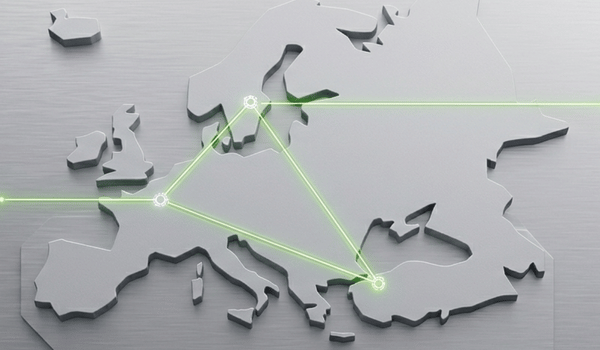
Over the past period, we’ve seen how 3D printing naturally extends beyond local applications. Raw Idea successfully delivered projects spanning multiple countries: production and shipment to Turkey, interior applications in Sweden, and a follow-up trajectory in France.
These are not isolated cases, but examples of how additive manufacturing integrates into international project structures. What used to require separate regional production setups can now be managed within a single digital workflow.
Designing for mobility and flexibility
Cross-border production requires more than printing parts. It demands systems thinking where design, logistics, and application are considered together.
A key advantage of 3D printing is the ability to design with mobility in mind. Components can be optimized for transport, assembly, and local adaptation from the outset. This reduces friction in delivery and allows faster response to project-specific requirements across different markets.
Speed and customization as a standard
One of the clearest benefits of this approach is the combination of speed and customization. Digital design enables rapid iteration, while additive manufacturing makes it possible to adapt outputs without retooling or reconfiguring entire production lines.
This flexibility ensures that projects can maintain a consistent design logic while still meeting local constraints or client-specific demands in different countries.
Distance becomes less relevant
A key shift emerging from these projects is that geography is no longer a fixed limitation. When design is fully digital and production can be localized or centralized depending on need, distance becomes a variable rather than a barrier.
This enables hybrid production models: centralized design expertise paired with distributed manufacturing capacity closer to the point of use.
Practical implications
For industries working across borders, such as design, architecture, and product development, this shift introduces clear advantages:
— Faster execution across multiple countries
— Reduced dependency on long, rigid supply chains
— Greater adaptability to local requirements
— More efficient coordination between teams and partners
In practice, this means production becomes more responsive, modular, and resilient.
Looking ahead
The projects completed across Turkey, Sweden, and France reflect a broader transition already underway. As digital manufacturing matures, international production will become increasingly fluid and interconnected.
Additive manufacturing is evolving into a system for coordinating production across borders, not just a method of making parts.
The future of production is not defined by location, but by connectivity, flexibility, and design intelligence.