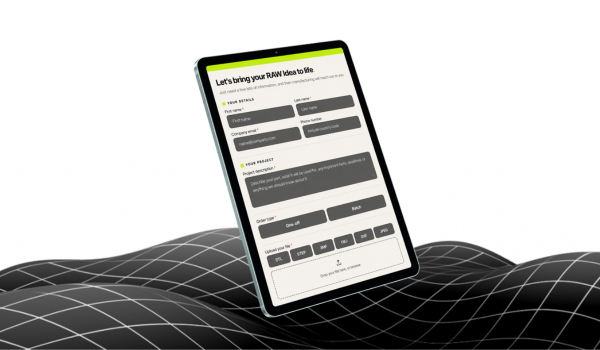
How RAW Idea is making the first step towards large-scale additive manufacturing clearer and more efficient.
It’s important that we set the stage for our customers and help them understand how we can bring their RAW ideas to life. But before that idea can become a physical product, it needs to be understood.
At RAW Idea, projects can begin in very different ways. A client may already have a detailed digital design and know exactly what they want to produce. Another may have a concept that still needs to be developed, tested or adapted for large-scale 3D printing.
Some projects are focused on a single prototype, while others are intended for a larger production run.
Understanding these differences from the start is essential. It allows us to determine what a project requires, what is technically possible and how we can best support the client throughout the process.
What Does Large-Scale 3D Printing Require?
Large-scale 3D printing is not simply a matter of sending a file to a machine. Design, material, dimensions, application, production volume and finishing all influence how a product should be manufactured.
At RAW Idea, we work across these stages: from design and development to production and post-processing. Our workflow is built around adapting the manufacturing process to the requirements of each project.
That is why the conversation before production matters. The more clearly we understand a project at the beginning, the more effectively we can determine the right approach. It also gives our team the information needed to assess feasibility.
A clearer starting point
To make this process more straightforward, RAW Idea is introducing a new project form on its website.
The form gives prospective customers a structured way to explain what they are looking to manufacture. It asks for information such as the project description, whether the requirement is for a prototype or a production batch, whether a final design is already available or development support is needed, and what material requirements may apply.
These details provide our team with a clearer picture before the first conversation takes place.
This is particularly relevant for large-scale additive manufacturing, where the requirements of the final application can influence everything from material selection to the way a component is designed and produced. RAW currently works with materials including PP, PETG and HDPE, while its production systems support different scales and approaches to large-format manufacturing.
Better information, faster decisions
The goal is simple: make the first step easier for both sides.
For customers, the form provides a clearer way to communicate what they need. For RAW Idea, it creates a more complete starting point for evaluating a project.
That can mean fewer questions to clarify basic requirements, a faster understanding of the manufacturing challenge and, ultimately, a more efficient route towards a quotation.
It also helps establish expectations early. If a project requires design development, for example, that can be identified from the outset. If a client already has a production-ready design, the conversation can focus on manufacturability, materials and production requirements instead.
In both cases, the objective is the same: start the project with the right information.
A small change at the beginning of the process
For RAW Idea, this is a relatively small change to the customer journey, but one with the potential to improve the entire process that follows.
Manufacturing starts long before a machine begins printing. It starts with understanding what needs to be made, why it needs to be made and what the final product needs to achieve.
By creating a clearer starting point, RAW Idea can make it easier to move from an initial idea to a concrete manufacturing project.
Because bringing an idea to life starts with asking the right questions.