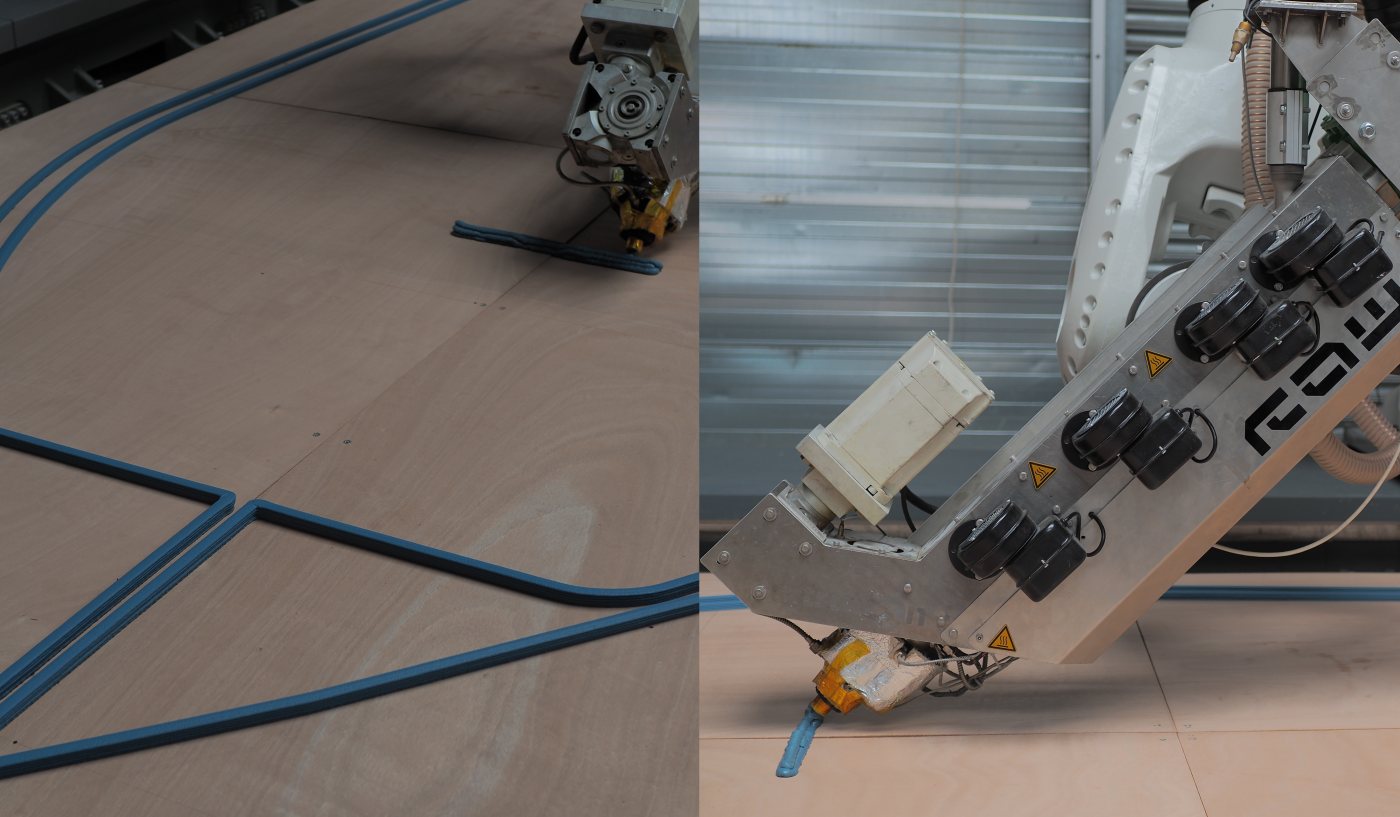
When you're working with large-scale robotic 3D printing, precision doesn't always come down to making the machine mechanically perfect.
Sometimes, the smarter solution is to make the process smarter.
One of RAW Idea's robotic 3D-printing arms has been giving the engineering team a particular challenge. At full extension, small movements in the arm were not being registered correctly by the software, causing the build plate to drift slightly during printing.
For the past few weeks, the team has been working on a solution — and the problem is now close to being fully resolved.
When Small Tolerances Become Big Problems
In large-scale additive manufacturing, precision matters at every stage of the process.
A robotic arm may operate within extremely small mechanical tolerances, but when the arm reaches full extension, those tolerances can begin to stack up. Even a small deviation can become visible in the final print.
In this case, the software wasn't registering the movement occurring at full extension. That meant the engineers had to manually calibrate where the build plate was drifting and compensate for it during the printing process.
It wasn't a dramatic mechanical failure.
It was a precision problem, and one that required a different way of thinking.
Letting the Process Calibrate Itself
Rather than attempting to eliminate every mechanical tolerance from the system, the engineering team looked for a way to account for those tolerances within the printing process itself.
As Reza Fattahi, RAW Idea's R&D Specialist, explains:
“At full extension, tiny tolerances stack up and start showing in the print. So instead of chasing a mechanically perfect machine, we let the process calibrate itself. Engineering problems don't always need engineering-grade solutions.”
This approach is particularly relevant to robotic additive manufacturing, where the interaction between hardware, software, material, and the printing environment can be just as important as the individual components.
The objective isn't always to eliminate variation completely.
Sometimes, it's about understanding it well enough to work with it.
From Manual Calibration to a More Reliable Process
The team has spent the final weeks of the month refining the calibration process and moving toward a permanent solution.
Once fully implemented, the correction should remove the need for the current manual intervention and allow the robotic arm to operate reliably across its full working range.
That means:
— More consistent positioning during printing
— Better control at full arm extension
— Less manual calibration
— A more reliable overall printing process
— Another step toward greater automation
The solution is expected to be fully resolved by next month.
What Comes Next for the Printing Floor?
With the issue nearing resolution, all of RAW Idea's robotic arms will be operational.
That opens up an interesting question: what will the printing floor look like when the entire system is running at full capacity?
More operational robotic arms mean more opportunities to experiment, iterate, and increase production. It also gives the team a chance to put the improvements made during development into practice.
For RAW Idea, every calibration challenge is an opportunity to strengthen and refine our manufacturing process, one improvement at a time.
One More Step Toward Precision
Large-scale 3D printing rarely comes without technical challenges. The difference lies in how those challenges are approached.
In this case, the solution wasn't to chase mechanical perfection. It was to understand where the system naturally deviates and build that knowledge into the process.
With the calibration issue nearly resolved and all robotic arms soon operational, the next few weeks could bring a very different kind of activity to the RAW Idea printing floor.
The machines are ready. Now we're curious to see what they can do.