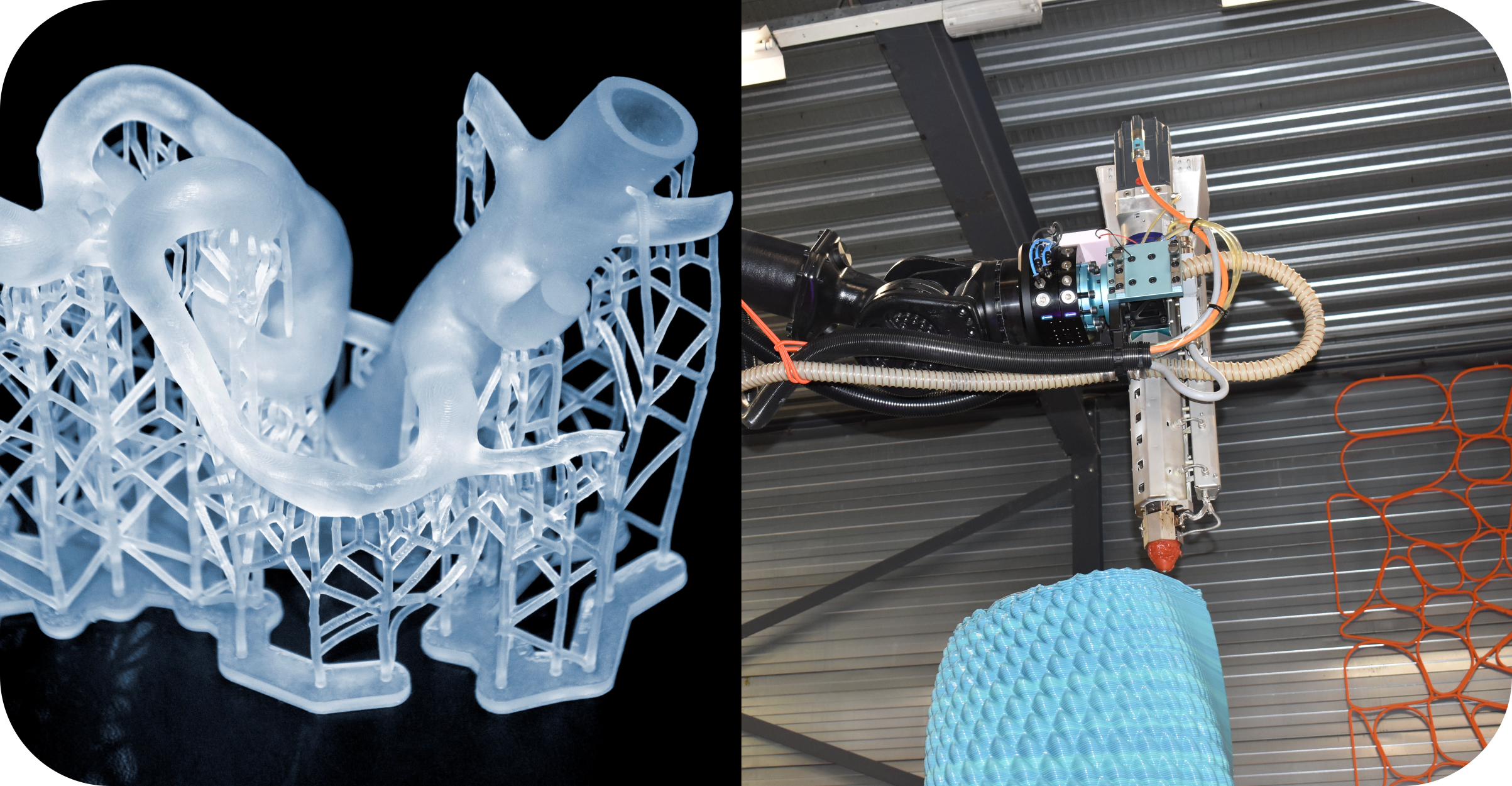
Why additive manufacturing matters now
For many years, 3D printing was primarily associated with innovation, experimentation, and rapid prototyping. It helped companies turn ideas into physical models faster and test designs before moving into traditional production. Today, that role is changing. Additive manufacturing is increasingly becoming a serious production technology, changing how companies think about building products.
Across industries, companies are looking for ways to make production more flexible, local, and efficient. Traditional manufacturing methods often rely on tooling, molds, large production volumes, and long development cycles. While these approaches remain valuable for many applications, they can limit agility in a market where customer expectations are changing rapidly.
Digital manufacturing introduces a different approach. Products can be designed, adjusted, and produced with fewer physical constraints, enabling organizations to respond faster to market needs and create solutions that were previously difficult or too expensive to manufacture.
The shift is not only technological. It reflects a broader change in how products are developed, produced, and experienced.
From making prototypes to creating final products
The maturity of additive manufacturing is visible in the way companies are applying it. Instead of viewing 3D printing as a step before traditional production, organizations are increasingly integrating it directly into their manufacturing strategies.
The key difference lies in the ability to produce complex, customized, and optimized parts without the limitations of conventional tooling. A digital file can become a physical product without requiring a new mold or extensive setup process. This creates opportunities for shorter production cycles, lower inventory requirements, and more responsive supply chains.
For example, industries such as aerospace, healthcare, automotive, and industrial equipment are exploring additive manufacturing for functional components, customized solutions, and low-volume production. Medical companies use it to create patient-specific devices, while industrial organizations use it to manufacture specialized parts that match specific operational requirements.
The value is no longer limited to speed. It is about creating a fundamentally different production model.
Designing differently: the real opportunity behind 3D printing
The biggest impact of additive manufacturing is not simply printing existing products in a new way. Its greatest potential lies in transforming how products are designed.
Traditional manufacturing often requires designers to work within the limitations of machining, assembly, and tooling. Additive manufacturing removes many of these boundaries and allows products to be developed around performance, function, and user needs.
This enables new approaches such as lightweight structures, integrated components, and products that are customized for specific applications. Instead of asking, “How can we manufacture this design?” companies can begin with a different question: “What is the best product we can create if manufacturing limitations are reduced?”
This shift in mindset is where organizations can unlock the true value of digital production.
Changing expectations from customers and markets
At the same time, customer expectations are evolving. People increasingly expect products that are more personalized, delivered faster, and better suited to their specific situation.
Mass production has traditionally focused on efficiency through standardization. Additive manufacturing creates new possibilities by combining efficiency with flexibility. It allows companies to produce variations, customize products, and respond to individual requirements without the same cost structures as traditional manufacturing.
This is especially relevant in markets where customer needs are diverse or constantly changing. Products no longer need to be designed only for the average user; they can be developed around real-world applications and specific experiences.
A more flexible and resilient production future
Beyond customization, additive manufacturing also contributes to a different approach to supply chains. Global production networks have shown vulnerabilities in recent years, increasing interest in more distributed and resilient manufacturing models.
Digital production makes it possible to move from storing large quantities of physical inventory toward managing digital inventories. Products can be manufactured closer to where they are needed, reducing transportation, lead times, and dependency on complex supply chains.
This does not mean traditional manufacturing will disappear. Instead, the future is likely to involve a combination of technologies, where each production method is used where it creates the most value.
What this means for organizations
For companies exploring the future of manufacturing, the important question is not whether 3D printing can replace traditional production completely. The more relevant question is where additive manufacturing creates strategic advantages.
Organizations should consider:
— Which products could benefit from greater customization or flexibility
— Where faster iteration and shorter development cycles create value
— Which components could be redesigned for improved performance
— How digital production can support more responsive business models
The companies that benefit most will not simply adopt new machines. They will rethink products, processes, and customer experiences from the possibilities that additive manufacturing creates.
Looking ahead: manufacturing without the old limitations
Additive manufacturing is entering a new phase. What started as a tool for innovation and prototyping is becoming an important part of modern production strategies.
The future of manufacturing will be shaped by organizations that combine digital capabilities with creative product thinking. The opportunity is not just to produce faster, but to create better products, smarter processes, and more adaptable businesses.
For RAW Idea, this confirms an important perspective: the true value of 3D printing is not found in the technology alone, but in the ability to redesign products and production around new possibilities.