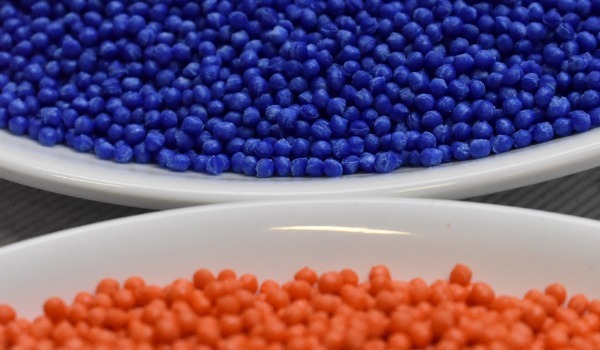
How we dry 250 million pellets
It sounds like clickbait, and to be fair, it is a little. But this is genuinely where the process starts for us: with 250 million pellets, or around 1,000 kilos of material, that cannot go anywhere near the printer just yet.
Our granulate arrives in the form of plastic pellets, delivered in big bags of roughly 1,000 kilos. At first glance, it may look like production ready material, but in reality that is only the beginning. Before a single pellet can make its way to the print head, the material first has to be dried.
Why drying matters
During storage and transport, plastic pellets absorb moisture from the air. That moisture may seem insignificant, but in the printing process its effect becomes visible immediately. Material that is too wet prints less evenly. Layers do not bond as cleanly, the strength of the part can be reduced and the visible quality of the final product also suffers.
That is why this step matters so much. What may seem like a technical preparation in the background has a direct impact on the final result.
From big bag to dryer
To prepare the material for production, we use a vacuum conveying system to transfer it from the big bag into the dryer. There, the granulate is heated in stages and held at temperature until it is ready for processing. During this step, moisture is removed from the material.
How long this takes, and at what temperature, depends on the material itself. It requires experience, process knowledge and careful control. In many ways, this is where the craftsmanship behind large scale 3D printing becomes clear.
A quiet step with visible results
Only after drying is the material ready to be used by the printer. And the difference shows. Layers bond better, the surface becomes cleaner and the final part performs more consistently in use.
3D printing can sometimes appear straightforward, but in practice it is built on many decisions made behind the scenes. Drying the material is one of them, and perhaps one of the most decisive steps in the entire process.
If you would like to learn more about 3D printing or are interested in one of our products, visit our shop and explore the collection.